Endangered data of endangered species
All species of bats that occur in Germany are endangered and of high conservation concern. Since all bat species are protected by national law and listed in the Council Directive 92/43/EEC issued by the European Union, continuous monitoring of bat populations are requested by national and international concern. To achieve efficient monitoring, we need information on actual population sizes and trends, as well as data on recent and past population dynamics. But, not only the bats are endangered, a substantial amount of data has been collected and archived over the years by voluntary bat researchers and conservationists but which have never been centrally analysed by standardized, modern statistics and which now become more and more faded into obscurity. Here, in a project funded by the BfN (Federal Agency for Nature Conservation in Germany) we will employ modern statistical methods to standardize previously unpublished data and combine them with published data to estimate annual population sizes on a country-wide scale. In addition, we will use data from individually marked populations to complement population size data with data on population dynamics. Ultimately we will standardize the data and establish a comprehensive database on bat population dynamics that should help us to monitor the effects of climate and environmental change on bat populations.
Central research questions:
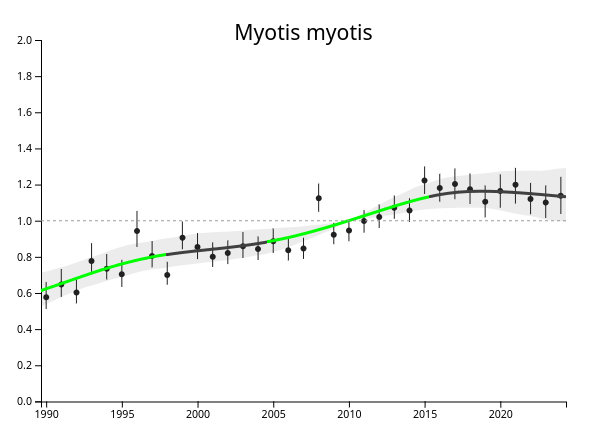
How have populations of different bat species developed in recent decades
In which direction are the trends currently developing?
How robust are current statistical estimation methods?
What are survival and reproduction rates and have they changed in recent years?
What is the demographic structure in the populations and has it changed over time?
Are there geographical differences between population dynamics and what factors might have an influence?
How can we improve efficiency for future monitoring surveys for bat conservation?
Results so far:
BATLAS - digital bat atlas
https://batlas.infoProposed form of citation:
BATLAS (2023): Portal für Fledermauspopulationstrends. Universität Greifswald (Hrsg.): Bedrohte Daten von bedrohten Arten - Projekt im Rahmen einer Zuwendung gefördert durch BfN mit Mitteln des BMUKN.Article:
- Statistical methodology, models (English, open access):
Schirmer, S., Scheuerlein, A., & Fritze, M. (2026): How to estimate overall population trends when sites show varying population counts over time?
Ecological Indicators: https://doi.org/10.1016/j.ecolind.2025.114588
R-Code: https://github.com/SaskiaSchirmer/HGAM_poptrends - Conceptual methodology (English, open access):
Fritze, M., Mayr, S., Scheuerlein, A., Kerth, G., Schirmer, S. (2026): BATLAS: A scalable citizen science platform for integrating biodiversity monitoring data with automatic population trend analysis. Ecological Informatics, 103817. https://doi.org/10.1016/j.ecoinf.2026.103817 - Overall description (German):
Fritze, M., Mayr, S., Scheuerlein, A., Kerth, G., Balzer, S., Neukirchen, M., Petermann, R., Bauer, J., Berg, J., Giese, G., Harbusch, C., Harder, J., Hoffmeister, U., Horn, J., Koch, R., Maetz, G., Meschede, A., Petzold, A., Pfalzer, G., Prüger, J., Rackow, W., Ripperger, S., Röse, N., Roßner, M., Roßner, S., Sauerbier, W., Schorcht, W., Schritt, K., Teubner, Ja., Teubner, Je., Thiele, K., Vollmer, A., Wielert, S., Zaenker, S., Zöphel, U., Schirmer, S. (2026): BATLAS: Bundesweiter digitaler Atlas zur Analyse von Fledermaus-Populationsdaten. Natur und Landschaft 101 (1), S. 2-13. https://doi.org/10.19217/NuL2026-01-01
Responsible for the project: